



Agentic payments are becoming one of the most interesting fintech topics because they answer a simple but powerful question: what happens when AI agents can not only recommend a purchase, but also complete the payment with permission, security, and accountability? This is not just another payments buzzword. It is the beginning of a new layer of digital commerce where software can compare options, choose a provider, request approval, pay, record the transaction, and help users manage the result.
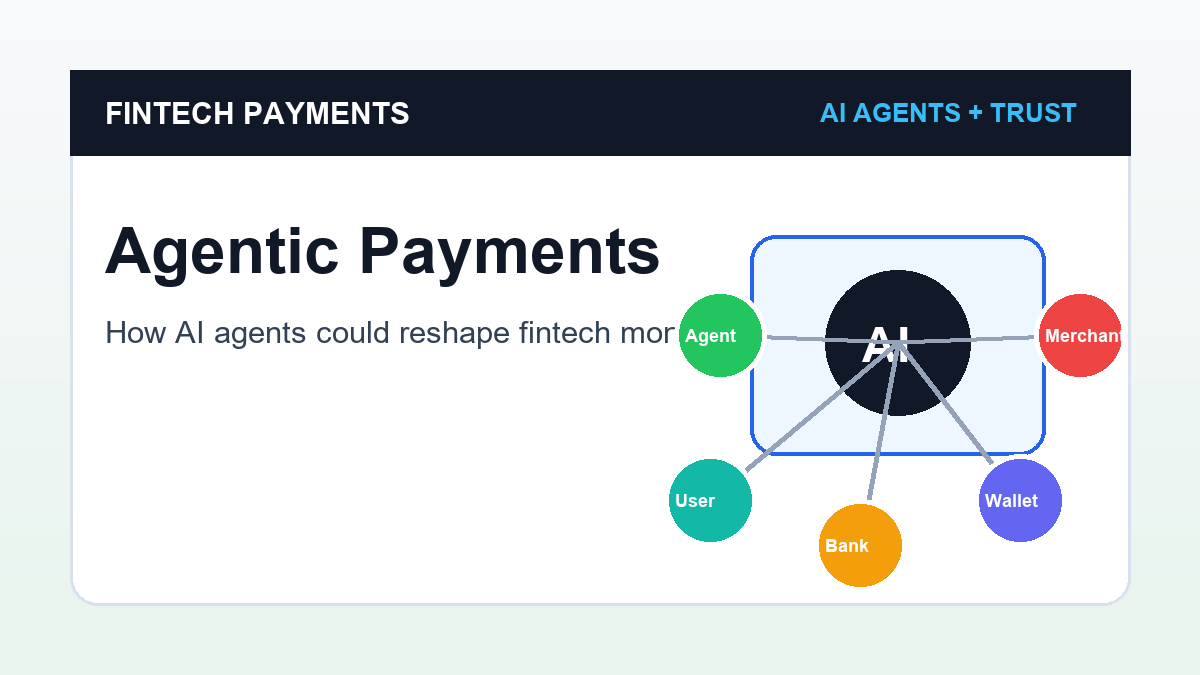
The reason this topic is trending is easy to understand. AI assistants are moving from answering questions to taking actions. Consumers already ask AI tools to compare products, plan trips, summarize bills, find subscriptions, and recommend financial choices. Businesses are also experimenting with agents that reorder inventory, buy software, analyze invoices, and automate procurement tasks. Once an agent can act, money movement becomes the next challenge. That is where agentic payments enter the fintech conversation.
Major payment companies are already building for this shift. Mastercard has introduced Agent Pay for Machines for programmatic machine-speed payments. Visa has researched agentic payments using onchain data and explored how AI agents are starting to pay for things. PayPal has studied how merchants are preparing for agentic commerce. The IMF has also examined how agentic AI may reshape payment systems, especially around authorization, settlement, compliance, and resilience.
This blog explains the topic in plain language. It covers what agentic payments mean, why the keyword has growing demand, how the model works, where the opportunity sits for fintech companies, and what risks must be solved before adoption can scale. The goal is not hype. The goal is a practical, human-friendly guide for founders, product managers, payment teams, banks, merchants, investors, and fintech readers who want to understand where AI-driven money movement may be heading.
What Are Agentic Payments?
Agentic payments are payments that are started gotten ready suggested or finished by Artificial Intelligence agents working for a person, business or system. The main idea here is that these agents are acting on our behalf. Normally a payment happens when a person clicks a button enters their card details says yes to a transfer or taps their phone.. With Agentic payments an Artificial Intelligence agent can do some of this work. It can look for the option pick a supplier check the budget make sure it follows the rules ask for approval and then start the payment through a secure system.
The agent is not supposed to be a rogue machine spending money freely. A safe agentic payment system needs permission, identity, spending limits, audit trails, dispute processes, and clear settlement rules. The most important question is not whether AI can click pay. It is whether the payment system can prove who authorized the agent, what the agent was allowed to do, which limits applied, and how the transaction can be reviewed later.
That is why Agentic payments are connected to Artificial Intelligence, digital identity, wallets, tokenization, stopping fraud, open banking, stablecoins, card networks, merchant checkout and following the rules. They are not a new button to click when you pay. They could become a way for Artificial Intelligence to power the way we do business.
| Payment type | Who initiates the action? | Main value | Main challenge |
|---|---|---|---|
| Traditional card payment | Human shopper | Familiar and widely accepted | Fraud, fees, and manual checkout |
| Open banking payment | Human user or approved app | Direct bank transfer and lower cost | Bank coverage and user experience |
| Recurring payment | Merchant under user mandate | Convenience for repeat billing | Subscription control and disputes |
| Agentic payment | AI agent under human or business permission | Automated decisions and payment execution | Authorization, trust, and accountability |
Why Agentic Payments Are Trending in Fintech
The demand behind agentic payments is growing because AI is moving deeper into daily workflows. A user may ask an assistant to find the cheapest flight, renew an insurance policy, choose a software subscription, or reorder office supplies. A business may ask an agent to monitor inventory, compare vendor prices, and pay approved invoices. A bank may use an agent to help customers manage cash flow. In each case, the agent is not only generating information. It is helping complete a task.
This creates a payments gap. Today, many AI assistants can recommend what to buy, but payment still requires a human-controlled checkout step. That is good for safety, but it limits automation. If an agent can manage the buying journey but cannot pay, the workflow remains incomplete. If it can pay without guardrails, the workflow becomes risky. The fintech opportunity is to build the safe middle ground.
There is also a commercial reason. Whoever controls the agentic payment layer may influence discovery, checkout, loyalty, fraud prevention, data, and settlement. Card networks want tokenized credentials to remain relevant. Wallets want to become agent-friendly. Banks want to protect deposits and customer trust. Stablecoin and blockchain companies see always-on programmable settlement. Merchants want higher conversion with lower fraud. Fintech startups see room for new products.
How Agentic Payments Work
A reliable agentic payment flow begins with intent. The user tells an agent what outcome they want. For example, “renew my business software plan if the price is below my budget,” or “book the cheapest refundable flight that arrives before noon.” The agent then gathers options, checks the rules, evaluates trade-offs, and prepares a payment request.
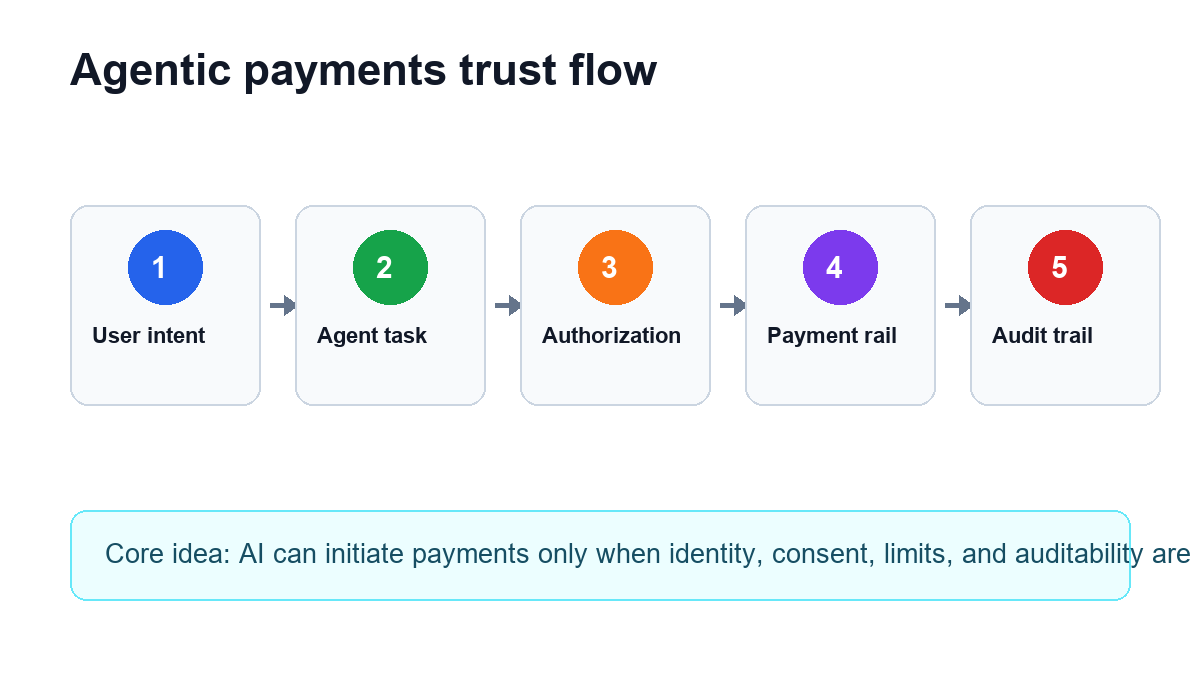
The next step is authorization. The payment system must know that the agent is approved to act. That may involve a tokenized credential, a spending limit, a one-time approval, a merchant category restriction, a time window, or a business policy. Then the payment moves through a rail such as a card network, wallet, bank transfer, or blockchain-based settlement layer. Finally, the transaction is logged so the user, merchant, bank, and compliance team can see what happened.
This is why many experts describe agentic payments as a trust problem before a technology problem. The AI model can make a recommendation, but the payment system must enforce rules. Payments require finality, recordkeeping, dispute handling, identity, and compliance. AI outputs can be probabilistic, but money movement needs deterministic controls.
13 Powerful Ways AI Agents Could Change Fintech
1. Agentic Payments Could Make Checkout Less Manual
One of the clearest use cases is checkout automation. Today, online checkout can still be clumsy. Users compare products in one tab, search for reviews in another, apply coupons, check shipping, enter payment details, and confirm the order. An AI agent could simplify that process by finding the right product, checking the user’s rules, and preparing a payment. The user may only need to approve the final choice or pre-authorize a narrow spending rule.
For merchants, this could change conversion. If agents become shopping intermediaries, product data, pricing, inventory accuracy, delivery terms, and return policies must be machine-readable. The merchant that makes it easy for trusted agents to understand and complete purchases may win more agent-driven traffic. The merchant that hides key information behind confusing pages may lose visibility.
For fintech providers, the opportunity is to create payment experiences where speed does not weaken control. A user might allow an agent to buy groceries under a weekly limit, renew subscriptions only below a set price, or purchase travel only after explicit confirmation. These controlled flows are where agentic payments become practical.
2. AI Agents Could Change Subscription Management
Subscriptions are a perfect target for AI assistance. Many users pay for apps, streaming services, cloud tools, memberships, and business software they rarely review. An agent could monitor recurring payments, compare usage, detect price increases, recommend cancellations, negotiate a cheaper plan where possible, or switch providers with approval.
In this model, agentic payments are not only about paying. They are about deciding whether a payment should happen at all. A good agent could ask, “You have not used this service in two months. Should I cancel before the next billing date?” For small businesses, the agent could review software spend, duplicate tools, unused seats, and renewal terms.
This creates a new kind of personal finance feature. Instead of showing a dashboard after money leaves the account, fintech apps can help users prevent waste before it happens. That is a more human version of automation: not just faster spending, but smarter control.
3. Agentic Payments Could Improve Business Procurement
Businesses spend a lot of time on procurement tasks that are repetitive but important. Employees need approved software, supplies, travel, parts, cloud credits, data services, and contractor payments. A well-governed AI agent could compare vendors, check company policy, route approval, and prepare payment. The finance team would still define the rules, but the agent would reduce manual work.
This is especially attractive for small and mid-sized businesses that do not have large procurement departments. They need control, but they also need speed. Agentic workflows could help them buy under approved limits, avoid duplicate spending, and keep better records. The payment becomes part of a broader workflow instead of a separate step at the end.
For fintech companies, this opens room for spend management tools that combine cards, bank payments, vendor management, AI review, and accounting sync. Internal articles like AI ERP automation tools already show how automation can reshape back-office workflows. agentic payments could push that automation directly into money movement.
4. Agentic Payments Could Make Cross-Border Commerce Faster
Cross-border payments are often slow, expensive, and hard to track. AI agents could help users compare payment routes, estimate fees, check exchange rates, and choose the most suitable rail. For example, an agent helping a freelancer receive international payment could compare bank transfer, wallet, card payout, and stablecoin settlement options.
The agent’s value would not be only speed. It could explain trade-offs in plain language: this option is cheaper but slower, this option is faster but has a higher fee, and this option requires extra verification. If authorized, it could then complete the payment using the selected rail.
This connects naturally with topics such as stablecoin payments and digital payment rails. Stablecoins may become one settlement option for agentic commerce, especially when always-on settlement and programmable transfers matter. But the winning products will likely abstract the complexity so users see clear choices, not technical rails.
5. AI Agents Could Reduce Payment Friction for Merchants
Merchants often lose sales because of friction. A buyer gets confused, abandons checkout, forgets a password, worries about shipping, or finds a better offer elsewhere. If an AI agent handles product comparison and payment preparation, the merchant’s job changes. The merchant must convince both the human and the agent.
This means agent-readable commerce could become important. Product feeds, inventory, refund policies, fraud signals, payment options, warranties, and delivery promises must be easy for agents to evaluate. Fintech providers can help merchants package this information and accept secure agent-initiated payments.
In the best case, agentic payments reduce abandonment because trusted agents can move shoppers from intent to completion. In the worst case, poorly governed agents create fraud, disputes, and customer confusion. The difference will come down to payment controls, merchant readiness, and user consent.

6. Agentic Payments Could Change Fraud Prevention
Fraud prevention will be one of the biggest battlegrounds. If AI agents can initiate payments, criminals will try to impersonate agents, trick users, create fake merchants, manipulate instructions, or abuse automated flows. Payment systems must learn to distinguish trusted agents from malicious bots.
That requires identity, tokenization, behavioral analytics, device signals, merchant verification, and transaction monitoring. A legitimate agent should carry proof of authorization. It should be bound to a user, wallet, device, or business policy. It should have limits. It should leave an audit trail. If something looks suspicious, the system should pause or require human confirmation.
This is where agentic payments connect with AI fraud detection. Fintech teams already use AI to monitor patterns and detect unusual behavior. The difference is that the agent may now be part of the transaction itself. Related ideas are covered in AI and cloud fraud prevention in fintech.
7. Agentic Payments Could Create Smarter Personal Finance Apps
Personal finance apps often show users what happened after the fact. They show balances, categories, spending charts, and alerts. AI agents could make these apps more proactive. A finance assistant could move money into savings, pay bills when cash flow is healthy, delay a non-urgent purchase, or warn when a planned payment would create a problem.
Of course, this requires careful design. Users may not want an agent moving money without clear consent. A practical system might use tiers: the agent can recommend, the agent can prepare, or the agent can execute within strict limits. A user might allow automatic bill payment under a fixed amount, but require approval for larger or unusual transactions.
This is a promising area for fintech apps because the experience feels helpful rather than flashy. agentic payments can make money management feel less reactive. The app becomes a financial co-pilot that acts only within boundaries the user understands.
8. AI Agents Could Help Banks Modernize Customer Service
Banks already use chatbots and virtual assistants, but many are limited to answering questions. Agentic systems could go further. A customer might ask, “Can you pay my card bill from my checking account, but leave enough for rent?” The agent would need to understand the request, check balances, confirm timing, apply limits, and complete or prepare the payment.
This could make banking support more useful. Instead of sending customers through menus, banks could offer task-based help. But banks also face higher trust requirements than ordinary apps. Every agent action must be explainable, reversible where possible, compliant, and secure.
For banks, agentic payments are not only a product opportunity. They are a governance challenge. Banks will need clear rules for consent, authentication, complaints, error resolution, model oversight, and third-party agents connecting to accounts.
9. Agentic Payments Could Support Machine-to-Machine Commerce
One of the more futuristic but practical use cases is machine-to-machine commerce. Imagine AI agents that buy compute resources, data access, API calls, cloud services, or digital tools from other systems. Some transactions may be very small, very frequent, and fully digital. Traditional checkout is not built for that style of commerce.
Mastercard’s Agent Pay for Machines points directly at this shift. The idea is that software services may buy and sell from one another at high speed, with payment controls built into the network. This could create new business models where agents pay for data, verification, compute, or specialized services only when needed.
This is where agentic payments could become infrastructure rather than a consumer feature. If agents become economic actors inside digital workflows, payment systems must handle high-volume, low-value, permissioned transactions reliably.
10. Agentic Payments Could Reshape Loyalty and Offers
Loyalty programs are going to change. Now people often forget about their points, coupons, credits or special offers linked to their cards. An agent can automatically check which payment method gives the reward. It can see if a coupon applies, if you should use your loyalty points and if the store has a deal through a wallet or bank app.
This sounds convenient for consumers, but it creates strategic tension for banks, card networks, wallets, and merchants. If agents optimize every transaction, loyalty must become more transparent and competitive. Hidden value may matter less because agents can compare benefits quickly.
Fintech companies can use agentic payments to create smarter offer engines. Instead of blasting generic promotions, they can deliver offers at the moment an agent is deciding how to pay. The challenge is to avoid turning the experience into noisy bidding that confuses users.
11. Agentic Payments Could Improve Cash Flow for Small Businesses
Small businesses often have trouble with cash flow. They get invoices customers pay late subscriptions renew, payroll is coming up and account balances change every day. An AI finance agent can monitor all these things. Tell you when to pay, when to ask for payment and when to delay non-essential spending.
With payment authorization, the agent could go further. It might pay approved invoices below a threshold, schedule supplier payments based on cash availability, or move funds between accounts. The business owner would still define rules and limits. The agent would reduce mental load.
This is a strong fintech use case because it solves a real problem. Many business owners do not need a complex dashboard. They need a system that says, “You can safely pay this invoice today,” or “Wait three days because two customer payments are expected.” agentic payments can make that advice actionable.
12. Agentic Payments Could Change Embedded Finance
Embedded finance already brings payments, lending, insurance, and banking into non-financial platforms. AI agents could make that model more dynamic. A travel platform agent could book, insure, and pay for a trip. A marketplace agent could recommend financing for a seller. A logistics platform could pay carriers automatically when delivery conditions are met.
The power comes from combining context with action. The platform already knows what the user is trying to do. The agent can interpret that context, suggest a financial step, and trigger payment with permission. This moves embedded finance from static products to intelligent workflows.
Fintech readers can connect this with embedded finance opportunities. agentic payments may become one of the ways embedded finance becomes more personalized, automated, and useful.
13. Agentic Payments Could Force a New Trust Standard
The biggest change may not be speed. It may be trust. If AI agents begin participating in payments, every player must answer hard questions. Who is the agent? Who authorized it? What exactly was it allowed to do? Did it follow the user’s intent? Can the transaction be disputed? Which party is responsible if the agent makes a poor choice?
These questions will shape the market. Payment companies that solve authorization, identity, auditability, and dispute handling may become essential infrastructure. Companies that focus only on flashy automation may struggle. Fintech is built on trust. AI does not remove that reality. It makes it more important.
That is why agentic payments are so attractive as a fintech topic. They combine AI excitement with serious payment problems. The winners will not be the loudest companies. They will be the ones that make agent-led transactions safe enough for real users and useful enough for real businesses.
Agentic Payments Comparison Table
| Use case | What the AI agent does | Fintech opportunity | Control needed |
|---|---|---|---|
| Consumer shopping | Compares products and prepares checkout | Agent-friendly wallets and merchant payments | User approval and spending limits |
| Subscription management | Reviews renewals and cancels waste | Personal finance automation | Clear cancellation and renewal rules |
| Business procurement | Checks vendors and policy rules | Spend management and B2B payments | Approval workflows and audit logs |
| Cross-border transfers | Chooses rails based on cost and speed | FX, stablecoin, wallet, and bank payment tools | Compliance and route transparency |
| Machine commerce | Buys compute, data, or digital services | Micropayments and programmable settlement | Machine identity and transaction caps |
| Small business cash flow | Schedules payments around balances | SMB banking and accounting automation | Cash flow rules and owner override |
Benefits, Risks, and Controls
The benefits of agentic payments are clear. They can reduce manual work, improve checkout, support smarter money decisions, increase merchant conversion, automate business workflows, and make financial apps more proactive. But payments are high-stakes. A small mistake can create a real loss, a customer complaint, a compliance issue, or a fraud event.
That is why the controls matter as much as the user experience. A strong agentic payment system should include identity verification, permissioning, spending limits, transaction context, merchant verification, data protection, dispute handling, and human override. The agent should not be a black box. Users should understand what it is doing and why.
| Benefit | Risk | Practical control |
|---|---|---|
| Faster checkout | Unauthorized purchases | Step-up approval for unusual transactions |
| Automated bill handling | Wrong payment timing | Cash flow rules and alerts |
| Better merchant conversion | Agent impersonation | Agent identity and tokenized credentials |
| Cross-border optimization | Compliance failure | Sanctions screening and audit trail |
| Machine-to-machine commerce | Runaway spending | Budget caps and rate limits |
| Smarter personal finance | Over-automation | Consent tiers and human override |
Key Points for Fintech Leaders
- agentic payments are about trusted AI action, not just faster checkout.
- The most important design problem is authorization: proving what the agent can do and who allowed it.
- Payment rails must support identity, consent, limits, traceability, and dispute handling.
- Merchants need machine-readable product data, policies, pricing, inventory, and checkout flows.
- Banks and fintechs can use agents to improve bill pay, cash flow, subscriptions, procurement, and customer support.
- Fraud prevention must evolve because attackers will try to impersonate trusted agents.
- The best products will keep humans in control while removing repetitive friction.
How Fintech Companies Should Prepare for Agentic Payments
Fintech companies should not wait until agentic commerce is fully mainstream before preparing. The first step is to map workflows where users already ask for help. Do customers need help choosing how to pay? Do merchants need better conversion? Do small businesses need payment timing support? Do banks need more useful digital assistants? Start with the workflow, not the technology.
The second step is to define permission levels. A good fintech product might separate recommendations, prepared actions, and automatic execution. For example, an agent can always analyze spending. It can prepare a payment under a certain amount. It can execute only for approved merchants. It must ask for confirmation if the amount, category, or timing is unusual. This layered model is easier for users to trust.
The third step is to build auditability. Every agentic payment should answer: what was the user’s instruction, what data did the agent use, what rule allowed the payment, which rail moved the money, and what confirmation was shown? Without this record, support teams and compliance teams will struggle.
The fourth step is partner selection. Fintech teams may need payment networks, wallet providers, open banking connections, stablecoin infrastructure, fraud tools, identity vendors, and merchant platforms. The agent is only one part of the stack. The payment ecosystem around it must be reliable.
The final step is user education. People may like the idea of AI saving time, but they may worry about giving software access to money. Clear language matters. Avoid vague promises. Explain limits, approvals, refunds, error handling, and how to pause the agent. Trust grows when users know they remain in control.
Agentic Payments Readiness Checklist
- Use case: Choose a narrow workflow where automation solves a real pain point.
- Intent capture: Make sure the user’s goal is specific, measurable, and stored.
- Authorization: Define what the agent can recommend, prepare, or execute.
- Payment rail: Select the best rail for speed, cost, acceptance, and compliance.
- Risk scoring: Monitor merchant, device, user, and transaction behavior.
- Limits: Apply spending caps, merchant restrictions, category rules, and time windows.
- Audit trail: Record instructions, approvals, decisions, and settlement details.
- Human override: Give users a simple way to pause, revoke, or dispute agent actions.
- Support process: Train teams to handle agent-related payment questions.
- Compliance review: Check obligations around privacy, fraud, consumer protection, and financial crime.
Where Agentic Payments Fit With Other Fintech Trends
agentic payments do not exist alone. They connect with several fintech trends that are already shaping the market. Open banking can help agents access account data and initiate bank payments. Stablecoins can support always-on settlement and programmable transfers. Tokenized credentials can let agents transact without exposing raw payment details. AI fraud detection can monitor risk. Embedded finance can place agent-led payments inside non-financial journeys.
This makes the topic attractive for fintech companies because it touches revenue pools. It can affect card issuing, merchant acquiring, wallet design, banking apps, B2B payments, subscriptions, cross-border transfers and small business finance. It is also less crowded than keywords like “AI in fintech” because it focuses on a specific action: AI agents paying or preparing payments under permission..
For readers who want a broader foundation, related Fintech Publishers articles on open banking ecosystems, AI in fintech customer experience, and digital wallets and cashless payments are useful context. Agent-led payments may combine pieces from all of these areas.
Common Mistakes to Avoid
The first mistake is treating agentic payments as a branding exercise. Adding the word agentic to a payment product does not make it useful. The product must solve a specific problem, such as reducing checkout friction, improving cash flow, managing subscriptions, or automating approved business spend.
The second mistake is giving agents too much freedom too early. Broad access creates risk. Start with narrow limits, low-risk flows, clear approvals, and strong logging. Expand only after the system proves reliability and users understand the controls.
The third mistake is ignoring merchant readiness. If agents cannot read product details, shipping terms, return policies, price changes, and inventory accurately, they will make poor recommendations. Agentic commerce requires better data hygiene from merchants and platforms.
The fourth mistake is underestimating support. Users will ask why an agent made a choice, how to cancel an action, what happens after a failed payment, and who is responsible for an error. Fintech companies need answers before launch, not after complaints arrive.
What This Means for Banks, Fintechs, and Merchants
For banks, agentic payments could become part of digital banking assistance. Banks can help customers pay bills, manage cash flow, prevent overdrafts, and make safer decisions. But banks must also protect trust, comply with regulations, and manage third-party agent access carefully.
For fintech startups, the opportunity is speed and specialization. Startups can build focused agentic tools for expense management, subscription control, merchant checkout, cross-border payments, or freelancer finance. The best startups will not try to replace the entire payment system. They will solve one painful workflow better than anyone else.
For merchants the shift is about discoverability and conversion. If AI agents influence buying decisions merchants need product feeds, transparent pricing trusted checkout and clear policies. The agent may become a gatekeeper, between customer intent and purchase.
For payment networks and wallets the challenge is to remain the trusted layer. They must prove that agent-initiated payments can be secure, traceable, interoperable and easy for users to control. This is why card tokenization, wallet permissions, passkeys and identity frameworks are becoming more important
Final Thoughts
agentic payments could change fintech because they move AI from advice to action. The next wave of financial technology may not be only about better dashboards or faster checkout buttons. It may be about intelligent systems that understand intent, apply rules, choose the right payment method, and complete money movement with human-approved control.
The opportunity is exciting, but the trust challenge is real. Payments are not like ordinary software tasks. Money movement needs authorization, finality, compliance, customer support, and accountability. AI can make payments more useful, but only if the system around the agent is designed carefully.
For fintech companies, the smart path is practical. Start with one high-value workflow. Keep users in control. Make every agent action explainable. Build strong limits and audit trails. Choose reliable payment rails. Prepare merchants and support teams. If those pieces come together, agentic payments may become one of the most important bridges between AI assistants and real financial activity.
FAQs
1. What are agentic payments?
Agentic payments are payments where an AI agent helps prepare, recommend, or complete a transaction on behalf of a user or business, based on permission, rules, and spending limits.
2. How are agentic payments different from normal online payments?
In normal online payments, a human manually chooses and confirms the payment. In agentic payments, an AI agent can assist with decisions, compare options, prepare checkout, or trigger payment within approved controls.
3. Are agentic payments safe?
They can be safe if they include strong authorization, identity checks, spending limits, fraud monitoring, audit trails, and human override options. Without these controls, they can create serious risk.
4. Why are agentic payments important for fintech?
They could change fintech by making payments more automated, personalized, and intelligent. Banks, wallets, merchants, and payment networks may use them for checkout, subscriptions, business payments, and cash flow management.
5. Can AI agents make payments without human approval?
Only if the user or business has given clear permission. A safer model is to allow AI agents to act within strict limits, such as approved merchants, fixed budgets, or low-risk recurring payments.